
The purpose of this article is to develop a reflection on the impact of AI in the entertainment and leisure industry, which includes tourism, and can be organized into two effects. First, AI will substantially increase the productivity of this industry. For example, we will increasingly encounter digital agents that fully advise a tourist in organizing their vacation. These types of innovations will lead to significant productivity increases in the industry and also to the feared reduction in the demand for labor. The second effect is that AI will generate significant growth in the industry, as it will lead to a substantial increase in the availability of leisure time for people. This article will focus on developing this second effect, as the productivity increase is easier to imagine.
Although the entertainment and leisure industries are closely related and often overlap, they are not the same. While the entertainment industry creates content and experiences to entertain an audience and aims to capture the public’s attention, the leisure industry provides activities and experiences, such as tourism, that people can enjoy during their free time with the goal of enriching their leisure time. A video game can be considered both a form of entertainment and a leisure activity, but mowing the lawn is a leisure activity that doesn’t necessarily fit the definitions of entertainment. While this distinction can be enriched, in this article, both industries are viewed from a highly integrated perspective.
Artificial Intelligence is a technology that underpins a wide range of services. This technology enables, among many other things, the automation of repetitive tasks, the development of virtual assistants, autonomous vehicle driving, the optimization of industrial and business processes, the development of robots that help with household tasks, the possibility of chatbots attending to customers 24/7, personalized education, and medical diagnosis and treatment, among many other services. The distinctive characteristic of this technology is that it is general-purpose, meaning it affects all industries, and as can be inferred from the examples presented, in all industries to a greater or lesser extent, there will be the substitution of some human work time by computer work time.
Gary Becker, Nobel laureate in Economics, extended microeconomic analysis based on consumers and businesses to a range of human behaviors that traditionally were not considered economic. One of the most important examples is the analysis of worker and family behavior, where one of his most significant contributions was the model of time allocation. In Becker’s model, where time is a constraint, it is considered that each individual has a fixed amount of time (for example, 24 hours a day). This time can be divided between paid work (employment) and free time or leisure time. Mathematically, the model is presented as:
T = L + l
Where people have a total time (T) that is divided between work (L) and leisure (denoted as l, to differentiate it from work). In Becker’s models, there is a demand for work that organizations fulfill, allowing the average worker to choose the amount of leisure time (l) according to their preferences for leisure, consumption, and income from their work hours.
This framework has allowed us to understand how, as income increases, people choose more leisure time. Huberman and Minns document the reduction in weekly working hours from 1870 to 2000, considering countries of the Old and New Worlds of the OECD. The evolution of working hours is represented in Chart 1. According to Becker’s constraint, time not allocated to work is available as leisure, so the chart shows the growth of leisure time over the years.
Chart 1: Evolution of working hours 1870-2000
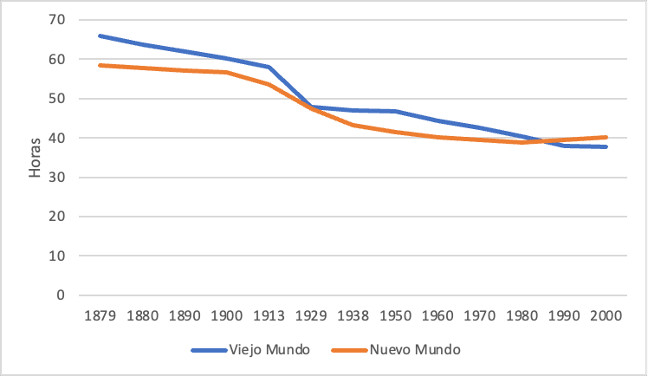
Note: New World: Australia, Canada, and the USA. Old World: Belgium, Denmark, France, Germany, Italy, Ireland, Netherlands, Spain, Switzerland, Sweden, and England. Source: Huberman and Minns (2007)
Robert Fogel conducts an analysis that not only looks at the economy as a source of change in time use. The author considers four major “Awakenings” in U.S. history. These are periods of religious revival and moral reform that had significant political and socioeconomic implications. Each of these awakenings was linked to technological advances and economic changes.
The data from Huberman and Minns and Fogel’s conceptual development show that leisure time will continue to increase over the years. While this availability of leisure seemed to increase gradually, in a context where people could choose how many hours to work, the AI technological revolution may not allow people to choose how many leisure hours (l) to have, as the demand for human labor will decrease, leading many people to have L = 0, and therefore, their leisure time may, in extreme cases, increase to l = T. Considering that the most important input for the leisure and entertainment industry is that people have available leisure time, we are facing an enormous opportunity for the industry.
This won’t be the first time the leisure and entertainment industry faces demand growth. In fact, the increasing availability of leisure time throughout history, along with socioeconomic transformations, has led to significant changes in the industry.
If the hypothesis that the AI revolution will free people by granting them more free time in a short period is confirmed, we will see a significant increase in the demand for entertainment. When this hypothesis materializes, the leisure and entertainment sector will have already incorporated the productivity advantages offered by AI, thus driving innovation at an accelerated pace. The increase in activity alone should raise the demand for labor in the sector. However, it is reasonable to think that, in a world saturated with AI, leisure and entertainment preferences will lean towards various forms of human interaction. Therefore, in the coming years, this sector could emerge as one of the industries with the greatest potential for job growth.
Faced with this hypothesis, how can we act accordingly? Entertainment as a service is based on a broad ecosystem that integrates content creators; the music, film, television, digital games, performing arts, publishing, and sports industries; distribution platforms; regulators; infrastructure developers; and the educational system.
Entertainment must fundamentally be identified with tourism to position itself as an essential pillar for the development of human well-being. In this understanding, research agendas and teaching processes should be organized around questions such as: What novel experiences can we create to captivate and entertain people? How do we develop entertainment experiences that promote people’s physical and mental health? How do we develop an environmentally friendly entertainment system? In what ways can technology help develop new forms of entertainment? These questions are currently addressed from different disciplinary areas, but the challenge, in the face of the hypothesis of AI’s impact, is to build a multidisciplinary agenda that proposes answers that lead to innovations that expand the industry’s economic activity.
In conclusion, the emergence of Artificial Intelligence in the leisure and entertainment industry will trigger two consequences. First, it will boost the sector’s productivity, and second, it will drive an increase in the demand for entertainment. The synergy between increased efficiency and rising demand outlines a horizon filled with unprecedented opportunities. To capitalize on this, it is essential for the education system to evolve, adopting an interdisciplinary approach that prioritizes human well-being. However, innovation should not be the sole responsibility of education, but of the entire entertainment ecosystem. We are facing an opportunity, and everything indicates that the sector will continue to flourish. As actors within this global ecosystem, we must reflect: Will we be mere consumers, or also active contributors to the production of leisure and entertainment?