
I consider that our mission as researchers, research centers, and training schools, in the development of sustainable territorial and tourism, must be guided by ethical principles that give meaning and values to our interventions in the development of communities. I believe that this is an urgent social demand.
1. CONTEXT OF GENERALIZED DISTRUST AND PROFOUND TRANSFORMATIONS.
We live in a continent with serious socio-economic and territorial inequalities, dissatisfaction with social services, and are actors in a deep institutional crisis. We are witnessing a process of extensive reforms: constitutional, educational, pension, tax, etc., in most countries in our region.
I consider that the success in the responsible development of Tourism in territories depends on many variables: their natural resources and heritage, companies, institutions, their offer of activities, security, among others. However, above all, it depends on the INTELLIGENCE of its leaders, professionals, technicians to take advantage of available resources and achieve a shared vision, achieve strong ASSOCIATIVITY, cooperation, and coordination among public and private actors.
However, at the present time, I consider it essential that an alternative development model focus on ETHICAL PRINCIPLES of the actions of institutions and professionals.
2. ETHICAL GUIDELINES IN THE ROLE OF THE UNIVERSITY AND SCIENCE IN THE DEVELOPMENT OF SUSTAINABLE TOURISM.
Ethics appreciated as values and models that guide research, training, and development and innovation actions that we seek to achieve.
HUMANISM PRINCIPLES that emanate from the dignity of the human being and the certainty of personal transcendence: respect for others, solidarity, equality of all members of our species, democratic coexistence, freedom, the pursuit of integral development, and protection of nature, identity, and cultural traditions of each people.
In our action, we operate within the scope of LEISURE AS A PERSONAL DEVELOPMENT EXPERIENCE and therefore travel, as spaces of coexistence, education, and personal growth.
In social intervention, advancing under the principle of the permanent SEARCH FOR TRUTH through scientific knowledge and effective linkage with territorial reality. Local development based on GREATER PARTICIPATION, with mechanisms of democracy in citizen decisions and shared responsibility of local actors. A very significant value is the EDUCATIONAL SENSE that we give to research work, tending to communities being able to achieve autonomy, methodologies being shared, and therefore benefits being equitable.
The greatest effort of development programs is focused on SOLIDARITY AND SOCIAL COHESION, promoting employment and income among young people and women, peasant families, small entrepreneurs of tourist services, giving PRIORITY TO ENDOGENOUS RESOURCES, promoting associativity, promoting and consolidating local leadership, taking advantage of technologies and good ancestral practices.
Research work seeks a high COMMITMENT in development programs, integration not only for diagnoses. FUTURE VISION, prioritizing special interest tourism (ecotourism, agritourism, scientific tourism, geological tourism, astronomical, indigenous tourism, among others), and incorporating the APPRECIATION made by public and private agents about the efforts we make.
ETHICS AT THE CENTER of cooperation agreements between university, governments, companies, and civil society, for a territorial development agenda with a focus on sustainable tourism.
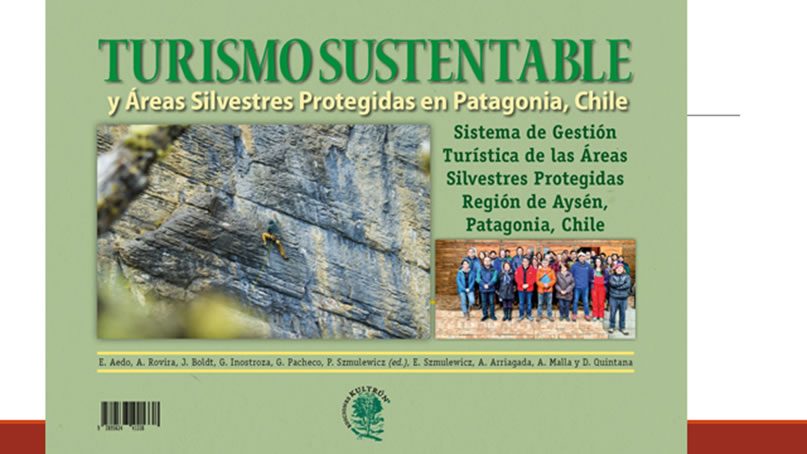
Manual de Turismo Sustentable en Areas Silvestres Protegidas en Patagonia, Chile, elaborado a partir de un Proyecto de I+D+i de la Universidad Austral de Chile.
